on new year's resolutions, interoception, self-carisms, and optimization culture
Bismillah. We begin everything with the name of Allah. We recite Bismillah to initiate an act, acknowledging the intention and ethics that follow.

☺️ Hello!
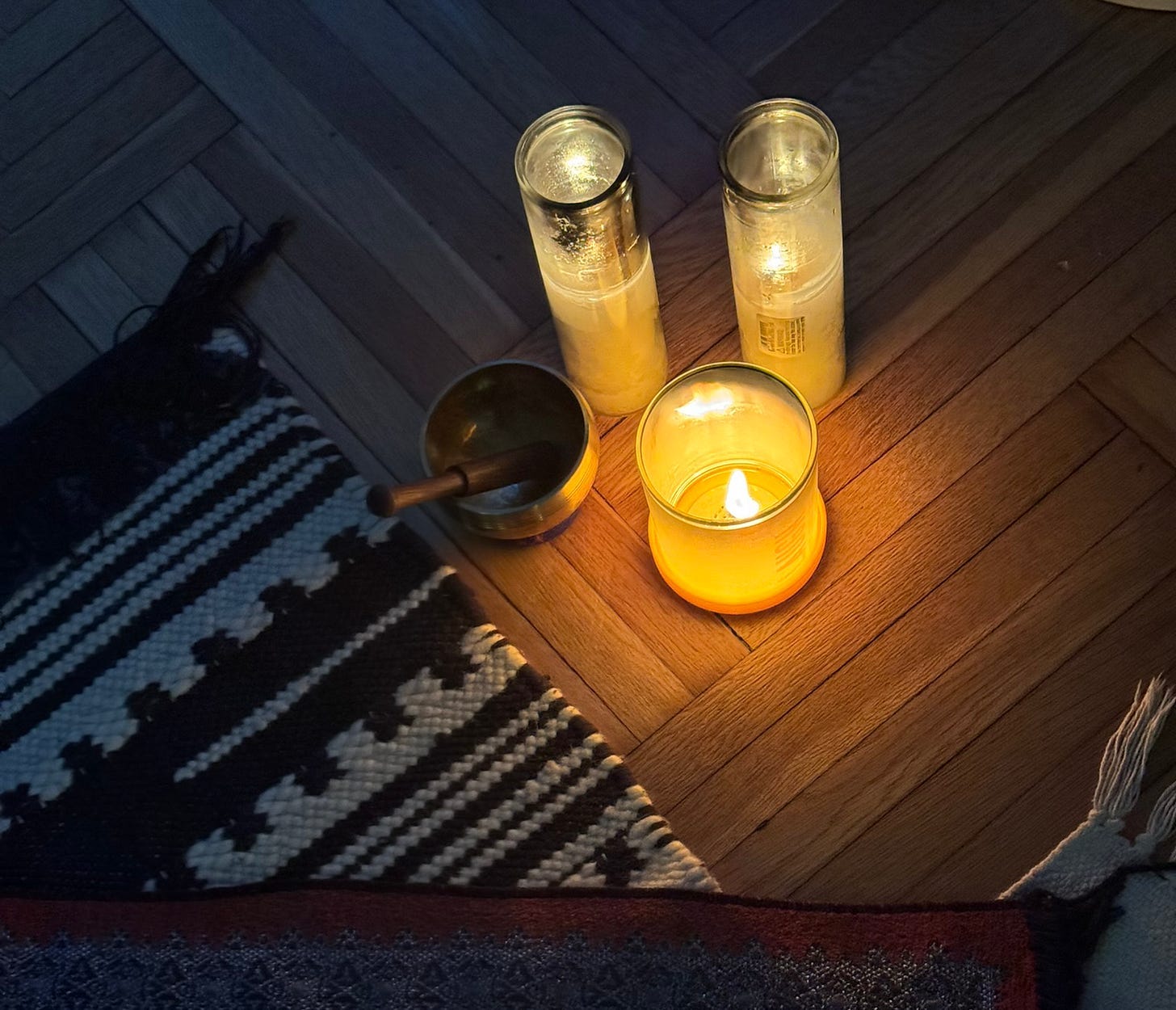
I. New Year’s Eve
I am proud of myself. On the 30th, I had a pedicure, a manicure, and a massage. Then I slept a lot.
Last night, I didn’t make any resolutions. I didn’t make any plans. I didn’t yearn. I just did whatever felt nice to me; it was a new experience.
I ate the rest of the sandwich I’d ordered earlier that day. It wasn’t great — too salty and bread too wet (I despise wet sandwiches), but it met its caloric requirements. I decided I really wanted Red Vines, so I ordered some and tinkered with some code. Here, I learned that it isn’t writing that I find difficult; it is the interface: I can write when it is a dispersed field of hyperlink sections with audio and diagrammatical interventions, but not straight through, top to bottom. I finished the central piece of writing I’d been working on all year. I sent out thank-you notes with this writing included.
In the corner of the living room where I’d tucked myself away, I toggled between tabs of random research while that tray of red snacks dwindled.
And, I danced to a lot — how come no one told me about Chappell Roan’s Pink Pony Club? I listened to it on repeat about 20 times. Is she okay? Please catch me up on this; I don’t have the patience to do it myself.
I FaceTimed family in South Africa and laughed about oxtail tacos. I FaceTimed my family in California and told my mama we need to stay in good health so that we can be elderly ladies cackling on the porch. I trolled the sibling group chat.
Then, I went to bed.
I woke up very slowly this morning. I swept and mopped. I ate some Goldfish and put away the Coke Zeros I left on the counter overnight. I tried on my new X-Files shirt (thank you, M + T!). I organized my tote bag. I FaceTimed my family in Johannesburg. We laughed about Americans who keep wild animals in their homes, bears that open people’s doors, and whether the Afrikaans expletive “voetsek” is understood by animals everywhere, regardless of location.
I logged into my MacBook and emptied a cart of things I felt were absolutely necessary just the evening before. Reentered the sibling group chat to complain about poor TV writing alongside Will Tavlin’s 2025 essay on N+1, Casual Viewing. I sat in the chair and watched some YouTube while I ate the most mediocre brisket pho.
I almost got distracted, but I wiped down the counter before sitting down to write this:
II. Interoception
10/10. I recommend doing what feels good in your body rather than some other nonsense. And sometimes, knowing what I am feeling, or even what feels good, is elusive.
I want to be chill, but I do not know how to relax. If not-ever-chill-even-under-threat were a person, it would be me. I always need to be doing something. I could watch a movie, but I could also research the geography of the featured location to ensure it was filmed on set, accurately portrays the scenery, and doesn’t exploit any location-specific lore. There is indeed a tiny, but loud (and passionately impatient) motor inside of me. More than anything, I rarely know that I need to relax until I am at the point of burnout.
Of course, it is anxiety — have to stay busy! But it is also about something called interoception, which complicates my little holy trinity of neurodivergence. Interoception is our perception of internal bodily signals. This includes things like knowing when you are hungry, thirsty, or cold. Interoception is a reminder that something is off-balance. I have struggled with interoception my entire life, even before I knew the term. I can sit for hours coding or writing without getting up to eat, drink, or use the bathroom. My mother recounts that I was absorbed for hours without interruption.
I have, like many people, outsourced my interoception. I rely on external cues to manage these internal signals. This outsourcing emerged incrementally. I realized I was not receiving internal cues to drink water or eat. Like, the signal was interrupted entirely, and I’d get to the end of the day, wonder why I feel delirious before realizing I’ve only had a cup of lukewarm coffee.
I have a CGM (constant glucose monitor) that sends a loud sound to my phone because I wasn’t feeling low blood sugar soon enough to prevent an emergency. I have an app that tells me when I should be feeling tired and when to go to bed. I use a 60-minute timer to remind myself to drink water. There is so much infrastructure and scaffolding to supplement what the body is supposed to do. An expired CGM device meant I’d have to go hours without knowing if I’d eaten enough. I will not get into the financial costs of wonky interoception. Maybe that is another newsletter.
III. Interoception under Optimization Culture?
I wondered why I needed a series of apps and people to help me eat and sleep. Why did my baby brother have to call me to ask, “Did you eat today?” As an adult, it feels weird; it feels infantilizing. I’d grown dependent on this external structure. I felt lucky to afford these supports, but also resentful.
Before I learned about interoception, I was confused but still ashamed.
When I began thinking about the relationship between interoception and capitalism, my awareness expanded. We are expected to move so fast — productivity and grind culture is the logic. Everything must be optimized. We do not have downtime. There is no aftercare. We have normalized the automation of most everything, so I no longer need to pause and ask how I feel. I get a pop-up that tells me what I should be feeling at a particular time, and what I should do or the commodity I should buy to address that need, before I even have a chance to let that sensory information settle.
Indeed, my interoception is impacted by my neurology; it is a “comorbidity.” But when you add the collective theft of leisure and unstructured time, it becomes easier (and truthfully, more feasible at times) to rely on an external cue to quickly tell us what to do than to slow down and do a body scan.
I want to be clear: I am not criticizing the use of these apps or structures. These can be lifelines, literally, for a range of disabilities. What I am criticizing is the convenient resistance to acknowledging the relationship between personal neurological conditions and socio-economic structures in the way that our interoception functions. It is not either or; it is both.
IV. Self-Carisms
We are offered self-carisms as a solution to our exhaustion, malnutrition, and anxiety. When I began to shape language around my interoception before I knew what it was, I was told to practice better self-care. The issue was that I was not being kind to myself. And I am sure that was part of it. But apparently, I was missing cues because I chose to ignore them, having not invested in the self-care gospel. These self-care campaigns do two dangerous things (among many others).
First, the structure of overzealous exploitation that normalizes our precarity, then resells often culturally appropriated and bastardized luxury objects and experiences back to us. We are offered a solution to a fictionalized problem: we are exhausted and overextended, not because we do not take “me time,” as we are told, but because the undermining and defunding of support structures alongside the wholesale theft of unstructured time creates this predictable (and profitable) predicament.
They benefit from the lie. And they benefit from the disingenuous solution.
I do not need a face mask. I need community. I need access to consistent healthcare.
Second, this self-care culture teaches us to defer our basic bodily needs until a more convenient time, ideally after 9-to-5. We need a spa weekend because during the week, we had to dissociate to make it to the weekend.
(There is more to be said here, but I want to take a nap and I am respecting this cue!)
IV. Interoception and Resolutions
This year, I decided not to make resolutions because I am choosing to stop bullying myself. The language of resolutions has often felt accusatory and punitive. Even with the shift away from grind-vision board-girl boss resolution culture toward less “measurable” goals, I still think there is a looming weight of completion and competition. These have never been generative motivators for me.
I do not want to become more optimized. I am a human, not a machine.
I do not want to outsource my self-awareness.
I want to be in my body.
I want to slow down and retrain my interoception so I can hear my needs more clearly.
Again, there is more here, but I want to sleep :)
My only commitments for 2026 are to engage in activities that restore the volume and consistency of my internal signals. A moment ago, I couldn’t tell whether I was hungry. I was about to look at my Apple Watch to check my blood sugar to see if I am at the nausea threshold. I stopped and said, “Are you hungry?” Sadly, I realized that I don’t know what that “feels” like; I usually rely on my watch, the onset of a migraine, or a message from one of my brothers. So I am making a list — a list of my body cues. Seems elementary, but I do not care.
I need to strengthen my antennae.
Thus far, I do not know what that will look like, but as a starter:
I will stay curious about my exhaustion cues. Then, I will rest when I am tired.
I will stay curious about my hunger cues. Then, I will eat when I am hungry.
Thank you for reading. All the best, always,
Kameelah 👽

Finally, while I don’t organize my finances around paid newsletter subscriptions, wouldn’t it be cool if this little newsletter let me take quarterly self-imposed writing retreats? Consider getting a one-year membership at USD 70 :)
How to cite this newsletter: Rasheed, K. (Year, Month Day). Newsletter Title. I Will (?) Figure This All Out Later. URL
I am so late, but here we are!
Coming back to this is fascinating because I realize that my interoception has not necessarily gotten better, but my awareness that I need to be more aware has ramped up, if that makes sense. What I have learned is that regaining this inner sensory mechanism requires more time doing nothing, so I can "hear" my body. Right now, everything is very loud, and I need quiet -- I am sometimes nervous about what I might learn and hear, but I know I need to.
I was telling a friend a few days ago that when I moved to NY I began writing a daily itinerary, a blank work doc with the date and a numbered list of what I had to do that day. It had about a week's worth of dates and an area for notes on the bottom. I have consulted this document every day for the past 12 years. What started out as a way to get organized turned into me offloading the work of memory onto a device. This, paired with my CPTSD, has been the deathblow to much of my memory, certainly my short term.
I felt this piece deep. My interoception (as usual, learning a new word from you) is completely out of wack and this really helped to illuminate that. Thank you so much for your vulnerability and your curiosity!